
Global Maritime Threats
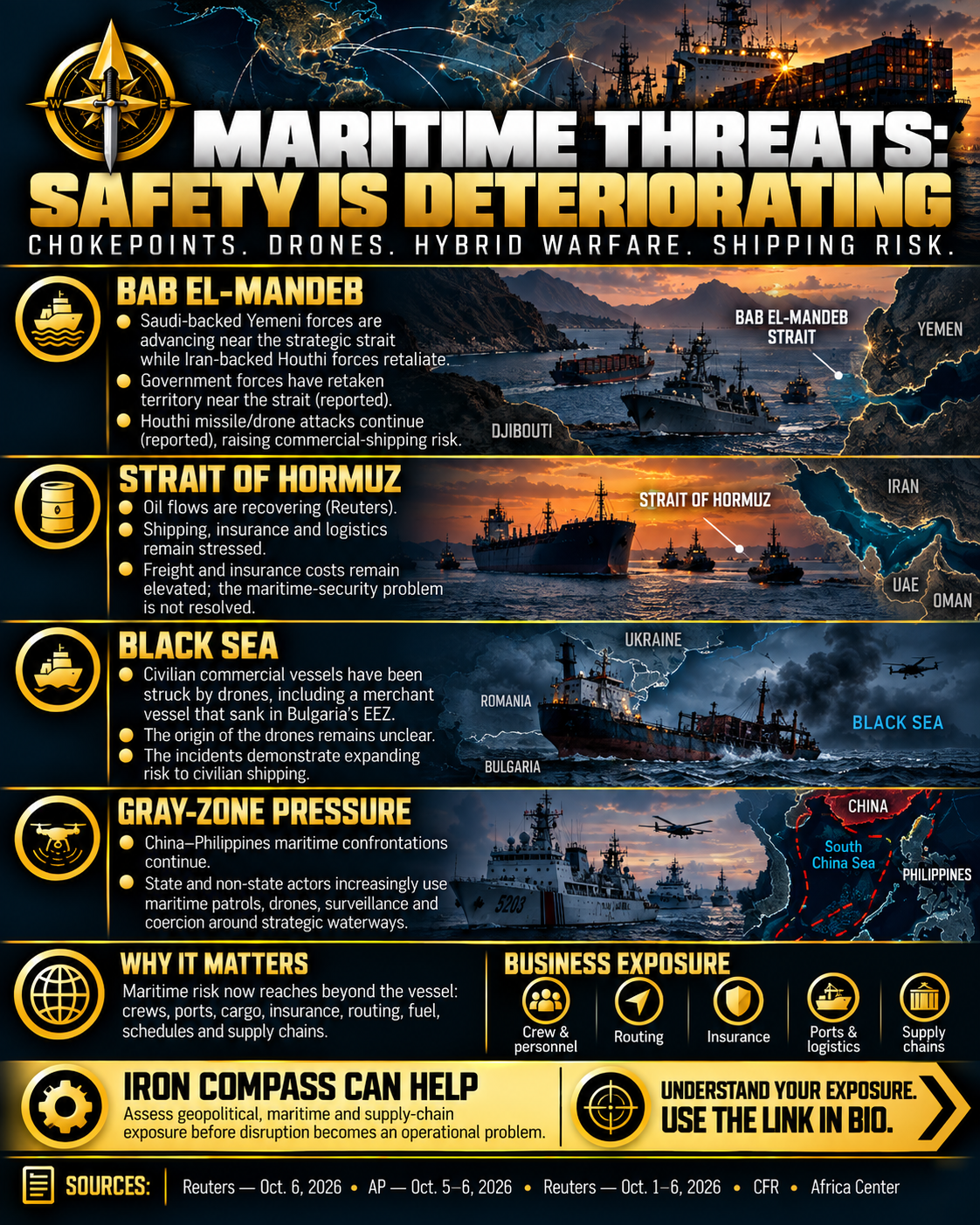
MARITIME THREATS: SAFETY IS DETERIORATING
Maritime security risks are expanding across multiple strategic waterways. In the Bab el-Mandeb, Saudi-backed Yemeni forces have launched an offensive against Houthi forces around the chokepoint, while attacks and retaliation continue to threaten commercial shipping. The Strait of Hormuz remains unresolved despite recovering energy flows; UK Maritime Trade Operations (UKMTO) continues to report attacks and suspicious activity involving commercial vessels, while the International Maritime Organization (IMO) has documented dozens of attacks on international shipping since the conflict began.
The Black Sea is producing another layer of risk. On October 6, two commercial vessels were attacked by drones inside Bulgaria's Exclusive Economic Zone; one sank and another was damaged, with the origin of the drones still under investigation. At the same time, China–Philippines maritime confrontations continue, including Chinese obstruction of a Philippine law-enforcement operation near Pag-asa Island. These incidents demonstrate how commercial shipping can become exposed to military conflict, gray-zone activity and unmanned systems well beyond traditional war zones.
For businesses, the threat extends beyond vessel safety. Routing, crew security, insurance, port operations, fuel costs and supply-chain continuity are increasingly interconnected with geopolitical risk. Companies operating through or dependent on vulnerable maritime corridors should assess alternative routes, exposure to disruption and the reliability of current threat reporting before an incident forces a response. Iron Compass helps businesses translate maritime and geopolitical developments into actionable security and continuity decisions.
SOURCES
Reuters — October 6, 2026
Associated Press — October 5–6, 2026
UK Maritime Trade Operations (UKMTO) — October 4–5, 2026
International Maritime Organization (IMO) — September 16, 2026
Reuters — October 1–4, 2026
Council on Foreign Relations — August 27, 2026