
Latin America’s Economic Outlook and the Strategic Importance of Panama Canal Security
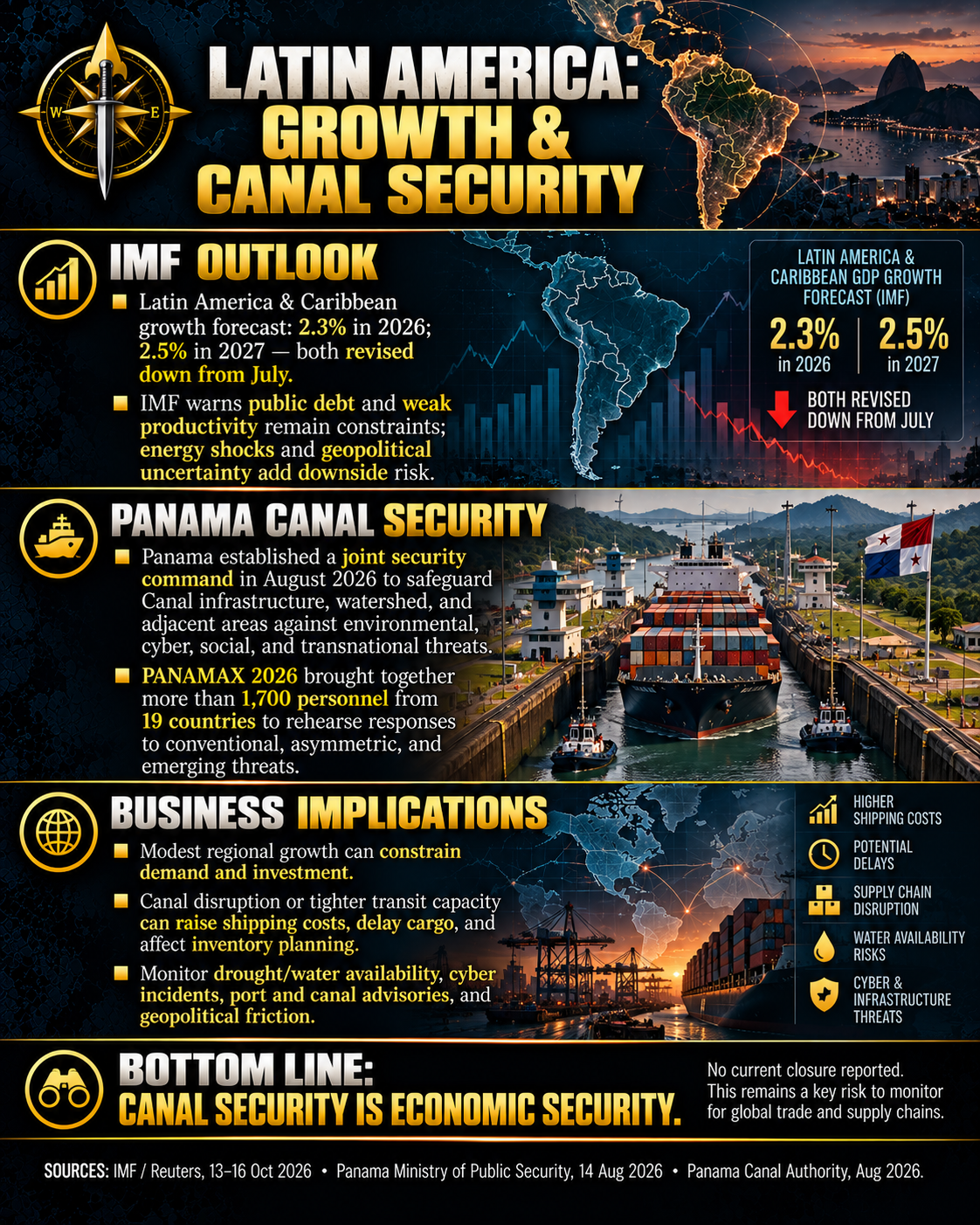
The International Monetary Fund’s (IMF) outlook for Latin America and the Caribbean points to continued but modest economic growth, with public debt, weak productivity, energy-market volatility, and geopolitical uncertainty presenting ongoing challenges. The IMF’s October 2026 projections cited in recent reporting place regional growth at 2.3% for 2026 and 2.5% for 2027, revised downward from July. For businesses, slower growth can constrain consumer demand, complicate investment decisions, and increase exposure to changes in financing costs, currency conditions, and regional political risk. Economic performance will vary across countries and industries, making country-specific assessments important for organizations operating in or sourcing from the region.
At the same time, renewed emphasis on Panama Canal security highlights the strategic relationship between infrastructure protection and global commerce. The Canal is a critical route connecting Atlantic and Pacific markets, supporting container shipping, energy transportation, agricultural exports, and other international supply chains. Panama’s reported security initiatives—including coordination to protect Canal infrastructure and surrounding areas against physical, cyber, environmental, and transnational threats—reflect the range of risks facing essential maritime infrastructure. Water availability is also a continuing operational consideration: drought conditions can constrain transit capacity, while cyber incidents, physical disruption, or heightened geopolitical friction could create additional uncertainty. These vulnerabilities do not mean a disruption is imminent, but they reinforce the importance of resilience planning around a globally significant chokepoint.
Businesses should monitor IMF forecast revisions, country-level fiscal and political developments, Canal Authority transit notices, water-level and capacity updates, port advisories, and credible reports of cyber or physical security incidents. Companies dependent on Canal transits should evaluate alternative routing options, delivery buffers, supplier concentration, and the financial consequences of longer voyages or higher freight costs. Investors and operators should also assess how regional growth conditions affect demand, counterparties, and project viability. The central takeaway is that economic conditions and infrastructure security are interconnected risks. Understanding both can help organizations anticipate disruption, protect critical operations, and make more informed decisions across Latin America and global trade networks.
SOURCES
International Monetary Fund (IMF), Regional Economic Outlook: Western Hemisphere: https://www.imf.org/en/Publications/REO/WH
Panama Canal Authority — Transit, operations, and official notices: https://pancanal.com/
Panama Ministry of Public Security — Official security announcements: https://www.minseg.gob.pa/
Reuters — Regional economic and infrastructure reporting: https://www.reuters.com/