
The U.S. Space Industry: Advancements, Vulnerabilities, and Strategic Implications
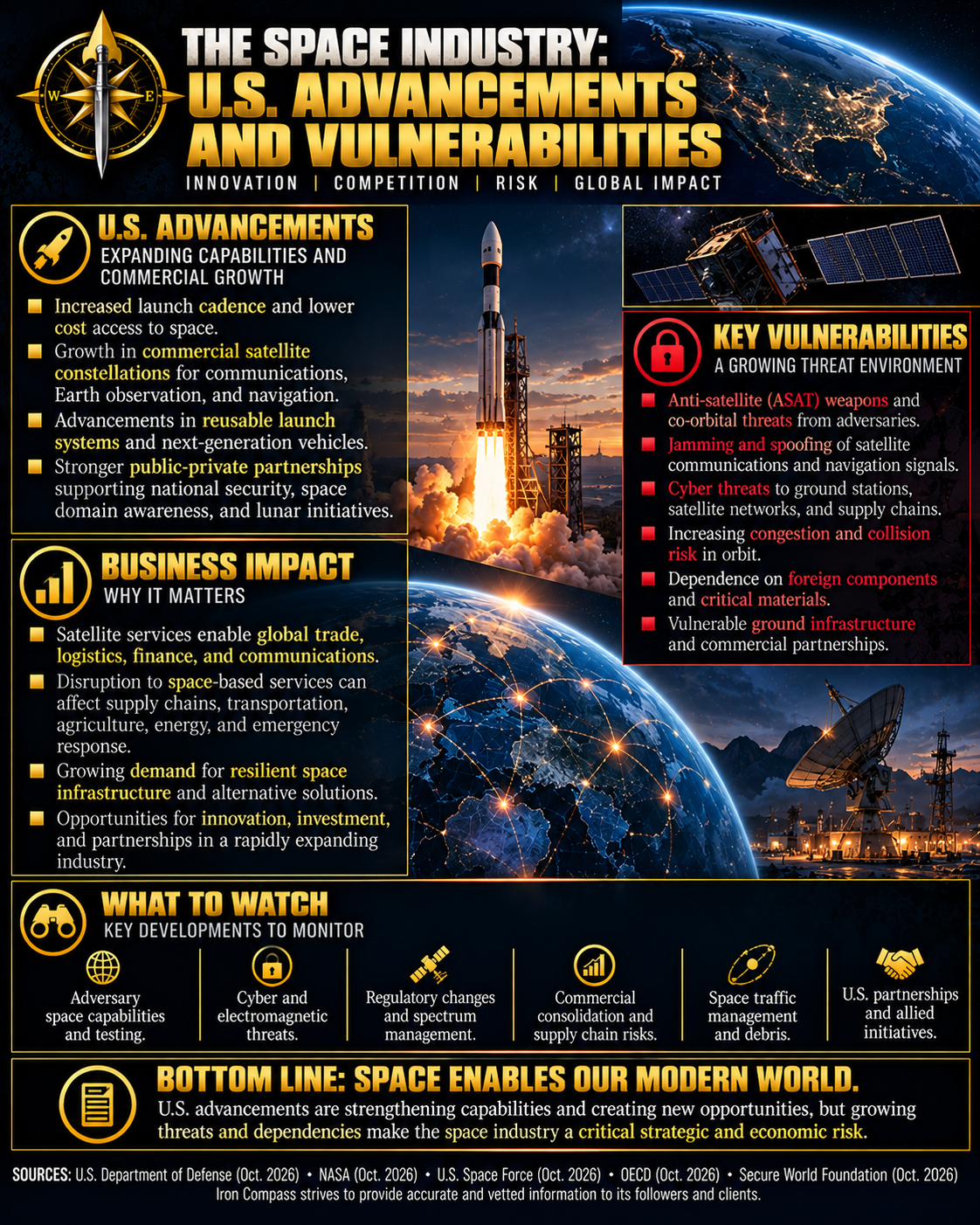
The United States continues to expand its space capabilities through commercial launch services, reusable launch systems, satellite constellations, and public-private partnerships supporting national security and scientific exploration. Satellite communications, navigation, and Earth observation underpin essential services across logistics, finance, agriculture, energy, emergency response, and defense. As commercial operators become increasingly integrated into government and civilian missions, space is no longer solely an exploration domain; it is critical infrastructure supporting economic activity and national security. These advancements create opportunities for innovation and investment while increasing dependence on systems that may be difficult to replace quickly if disrupted.
That dependence creates several vulnerabilities. Satellite communications and navigation can be affected by jamming and spoofing, while ground stations, satellite networks, and supporting supply chains face cyber risks. Adversary counterspace capabilities, orbital congestion, and collision hazards add further operational challenges. Reliance on specialized components, critical materials, and a limited number of commercial providers can also introduce supply-chain and continuity risks. A disruption to space-based services could extend into terrestrial operations, affecting transportation, timing-dependent financial systems, communications, and emergency response. The scale of the impact would depend on the service affected, the duration of the disruption, and the availability of alternative systems.
Organizations operating in or dependent on the space sector should monitor adversary capabilities, cyber and electromagnetic threats, spectrum-management decisions, orbital debris, supplier concentration, and changes in U.S. and allied space partnerships. Businesses should identify which essential functions depend on satellite services, evaluate backup communications and navigation options, and assess the resilience of critical suppliers. For investors and emerging-technology companies, these vulnerabilities also create demand for resilient architectures, cybersecurity, space-domain awareness, and diversified supply chains. The bottom line: U.S. space advancements are expanding strategic and commercial opportunities, but growing dependencies make space infrastructure a critical economic and security concern. Resilience requires understanding not only what space systems enable, but also how their disruption could affect operations on Earth.
SOURCES
NASA — https://www.nasa.gov/
U.S. Space Force — https://www.spaceforce.mil/
U.S. Department of Defense — https://www.defense.gov/
Secure World Foundation — https://swfound.org/
OECD — https://www.oecd.org/