
Unmanned Maritime Systems: Advancing Maritime Security While Facing New Vulnerabilities
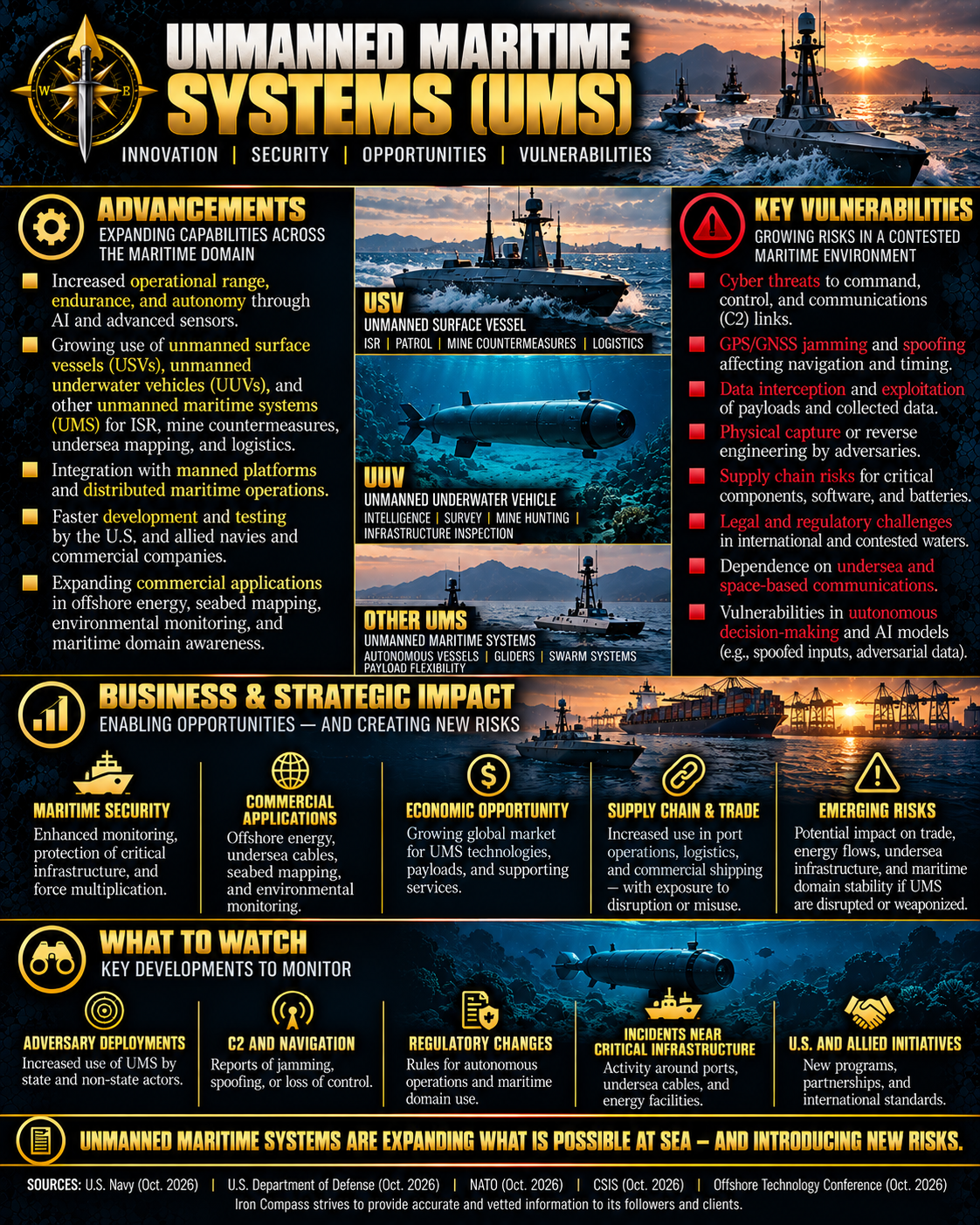
Unmanned maritime systems (UMS) are expanding the capabilities of military and commercial operators across the maritime domain. These systems include unmanned surface vehicles (USVs), which operate on the water’s surface, and unmanned underwater vehicles (UUVs), which operate below the surface. Advances in autonomy, sensor integration, endurance, and remote operations are enabling new applications in intelligence, surveillance and reconnaissance (ISR), mine countermeasures, hydrographic surveying, infrastructure inspection, logistics, and environmental monitoring. The U.S. Navy, allied forces, and commercial operators are investing in these capabilities to extend operational reach, reduce risk to personnel, and improve maritime domain awareness. As the technology matures, unmanned platforms are becoming an increasingly important component of distributed maritime operations and commercial infrastructure management.
These advancements introduce vulnerabilities that extend beyond the vehicles themselves. Cyberattacks against command-and-control (C2) systems, communications links, and supporting networks could compromise availability or data integrity. Global Navigation Satellite System (GNSS) jamming and spoofing can degrade navigation and timing, while interference with communications may limit remote control or mission updates. Autonomous systems also depend on reliable sensor inputs, software, and decision-making logic, creating risks from manipulated data or unexpected operating conditions. Physical capture, reverse engineering, and weaknesses in batteries, specialized components, or software supply chains can expose sensitive technology. For systems operating near ports, energy facilities, pipelines, and undersea cables, compromise or misuse could also create broader security and economic consequences. The actual impact depends on the platform, mission, safeguards, and operating environment.
Organizations should monitor changes in UMS deployment, autonomy and navigation resilience, cybersecurity standards, regulatory frameworks, and activity near critical maritime infrastructure. Commercial operators should assess the security of vehicle control systems, software updates, sensor data, communications pathways, and third-party suppliers. Infrastructure owners should consider how unmanned systems could support routine inspection and monitoring while also evaluating procedures for identifying and responding to unauthorized activity. For investors and technology companies, growing demand for reliable unmanned platforms may create opportunities in secure communications, resilient navigation, sensor integration, testing, and lifecycle support. Unmanned maritime systems are expanding what is possible at sea, but their strategic value depends on the resilience of the technology, networks, and supply chains that support them.
SOURCES
U.S. Navy — Unmanned systems and maritime programs: https://www.navy.mil/
U.S. Department of Defense — Autonomy, innovation, and defense technology: https://www.defense.gov/
NATO — Maritime security and emerging technologies: https://www.nato.int/
Center for Strategic and International Studies (CSIS) — Maritime security and defense analysis: https://www.csis.org/
U.S. Maritime Administration — Maritime security advisories: https://www.maritime.dot.gov/msci