
Global Protests and Demonstrations: Implications for Political Stability, Economic Security, and Geopolitical Competition
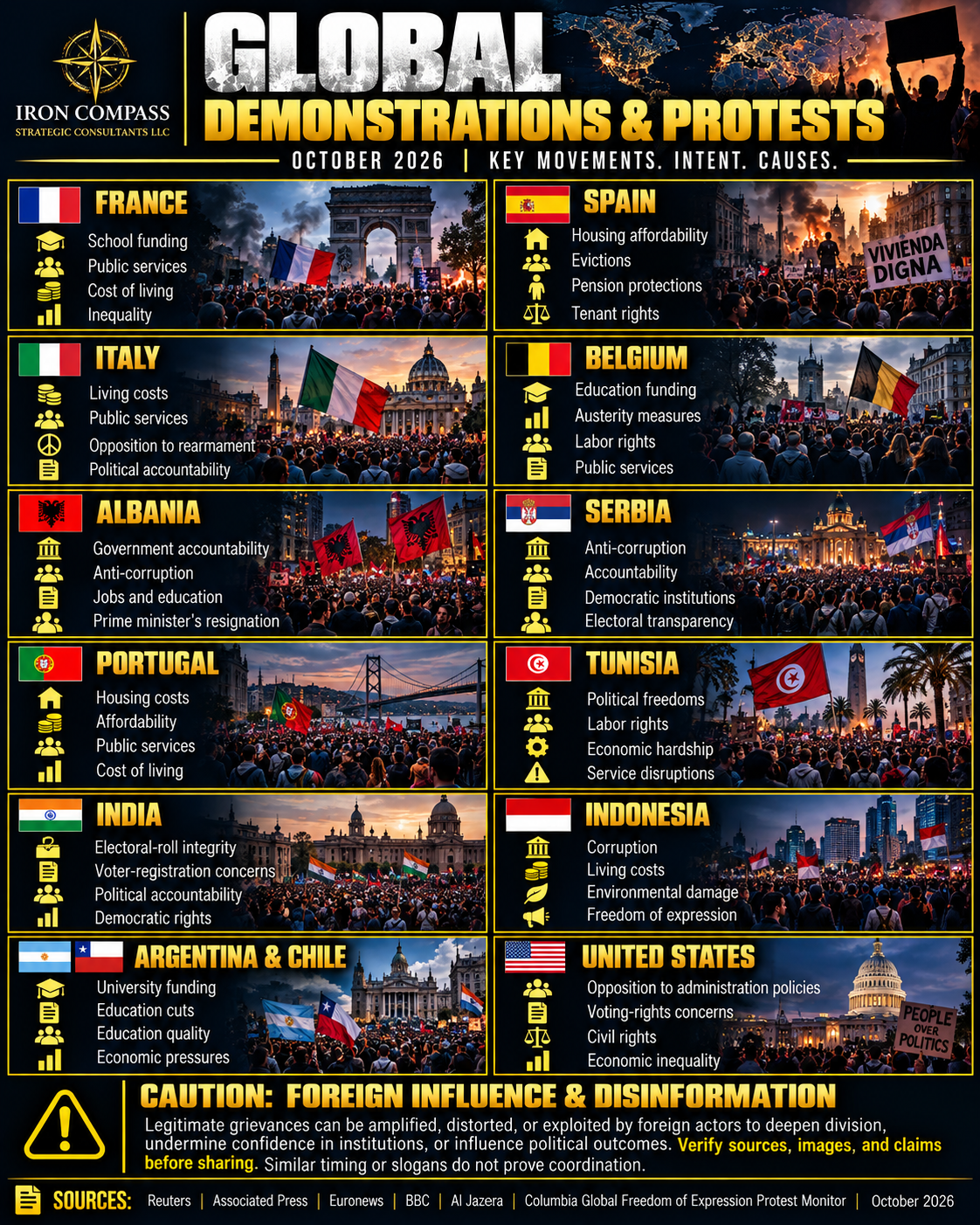
Demonstrations across Europe, Asia, Africa, and the Americas reflect a convergence of domestic pressures with potential implications for political stability, economic security, and international relations. The October 2026 overview identifies recurring grievances involving the cost of living, housing affordability, public services, corruption, electoral integrity, civil rights, and government accountability. Although the causes differ by country, the broader pattern highlights the challenges when economic insecurity intersects with declining public confidence in political institutions. Sustained unrest can constrain government decision-making, disrupt commercial activity, intensify political polarization, and create uncertainty for businesses and investors.
Political stability may come under pressure when demonstrations evolve from specific policy disputes into broader demands for leadership changes, institutional reform, or electoral accountability. Governments may face competing demands to restore public order, maintain essential services, and preserve civil liberties. Their responses can affect public trust, institutional legitimacy, and relationships with opposition movements.
Economic security is also at risk when recurring demonstrations disrupt transportation networks, ports, commercial districts, public administration, or labor activity. Prolonged uncertainty can delay investment, interrupt supply chains, and complicate business continuity planning, particularly in sectors dependent on predictable transport and government operations.
Defense and foreign policy may be affected if domestic pressure forces governments to reconsider spending priorities, delay policy initiatives, or devote additional resources to internal security. In countries already experiencing political or economic fragility, unrest may also complicate diplomatic engagement and create opportunities for external actors to pursue strategic interests.
Foreign influence and disinformation represent an additional risk during periods of heightened social tension. State and non-state actors may attempt to exploit existing grievances through coordinated messaging, misleading imagery, fabricated claims, or selective amplification of genuine incidents. Such activity can intensify polarization, undermine confidence in elections, and weaken public trust in government institutions. The incorporation of Artificial Intelligence (AI) into these campaigns has seemingly increased the volume and availability of such measures, further calling into question the legitimacy of what is presented through digital media.
Relevant escalation indicators include sustained increases in protest participation, the spread of mobilization beyond major cities, labor-union involvement, disruptions to critical infrastructure, changes in security-force posture, emergency government measures, and policy concessions. Businesses with international exposure should review personnel security, travel guidance, supply-chain dependencies, site access, and continuity arrangements in locations experiencing sustained civil unrest. The key judgment is that widespread protests are most consequential when they expose persistent weaknesses in public trust, economic resilience, or institutional responsiveness. Their strategic significance lies not simply in the crowds on the streets, but in whether the underlying pressures persist, affect government decisions, disrupt essential activity, or become exploitable by actors seeking to influence domestic or international outcomes.
SOURCES
Reuters — World News
Associated Press — World News
BBC News — World
Euronews — Europe
Al Jazeera — News and Analysis
Columbia Global Freedom of Expression — Protest Monitor
U.S. Department of State — Foreign Information Manipulation and Interference
Reporting period: October 2026. Country-specific protest details, participation figures, and allegations of foreign involvement should be verified against current, independent reporting before publication.